

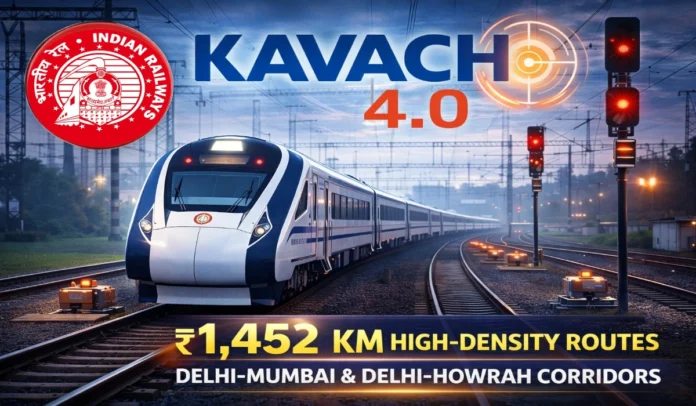
Indian Railways has taken a major step forward in passenger and freight safety by commissioning the latest version of its indigenous Automatic Train Protection system, Kavach 4.0, on 1,452 route kilometres of high-density corridors.
The system has been activated on critical sections of the Delhi–Mumbai and Delhi–Howrah main lines two of the busiest and most accident-prone routes in the country. Kavach 4.0 uses advanced radio-based communication, GPS, and trackside equipment to continuously monitor train speed, automatically apply brakes if the loco pilot exceeds permitted limits, prevent signal passing at danger (SPAD), and ensure safe headway between trains even in poor visibility or foggy conditions.
The deployment covers key high-traffic sections where trains run at relatively higher speeds and carry heavy passenger and freight volumes. With Kavach 4.0 now live, the risk of collisions, derailments due to over-speeding, and human-error-related incidents on these routes is expected to reduce significantly.
Developed entirely in India by the Research Designs & Standards Organisation (RDSO) in collaboration with Indian industry partners, Kavach has evolved through multiple versions. The 4.0 release brings improved reliability, faster response times, better integration with existing signalling systems, and enhanced cybersecurity features all critical for scaling the technology nationwide.
Railway Minister Ashwini Vaishnaw described the commissioning as a landmark achievement in the mission to eliminate train collisions. He said the government remains committed to covering the entire broad-gauge network with Kavach in a phased manner, with priority given to high-density and accident-prone sections.
The current coverage of 1,452 km adds to earlier installations and takes the total operational Kavach network beyond 2,500 route km. Trials and rollout continue on other busy corridors, including sections in the South Central, South Eastern, and Northern Railways zones.
Officials noted that Kavach 4.0 has already demonstrated high dependability during extensive field trials and is fully compatible with Indian Railways’ long-term goal of achieving zero passenger train collisions caused by human or signalling errors.
