
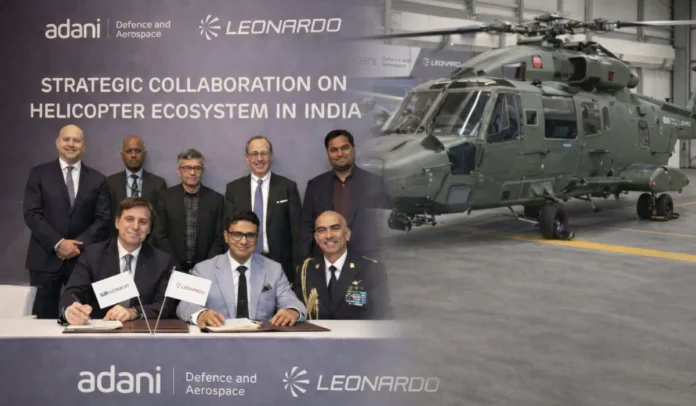
Adani Defence & Aerospace has signed a memorandum of understanding (MoU) with Italian aerospace and defence company Leonardo to create a fully integrated helicopter manufacturing ecosystem in India. The agreement, announced on Tuesday, focuses on developing, producing, and supporting helicopters to meet the growing needs of the Indian Armed Forces while advancing the country’s self-reliance goals in defence production.
The partnership targets Leonardo’s advanced models, particularly the AW169M and AW109 TrekkerM helicopters, which are suited for military roles including utility, training, and light attack missions. It includes phased indigenisation of components, setting up robust maintenance, repair, and overhaul (MRO) facilities, and providing comprehensive pilot training programs. This approach aims to build long-term capabilities within India rather than relying solely on imports.
The MoU was signed in New Delhi in the presence of senior government officials, including Defence Secretary Rajesh Kumar Singh and Director General (Acquisition) A Anabarasu from the Ministry of Defence. Jeet Adani, Director of Adani Defence and Aerospace, called the collaboration a shared commitment to India’s transformation. He highlighted how it would strengthen domestic aerospace skills and position the country as a stronger player in global defence manufacturing.
Leonardo brings extensive expertise as a leading helicopter maker, with a proven track record in supplying platforms to various armed forces worldwide. Adani Defence & Aerospace, part of the Adani Group, has grown rapidly in India’s defence sector through its work in unmanned systems, small arms, and other areas. This tie-up expands its footprint into rotary-wing aircraft and aligns with the Make in India initiative to boost local production and reduce import dependence.
India’s military has a large requirement for helicopters in the coming years, with estimates suggesting a need for hundreds of units across different categories. The partnership responds to this demand by combining foreign technology with Indian manufacturing strengths. It could eventually extend to civil aviation uses, though the initial focus remains on defence needs.
The deal supports broader government efforts to create jobs, develop supply chains, and transfer technology in the aerospace sector. It comes shortly after similar partnerships in aviation, showing growing interest from global firms in India’s defence market.
