
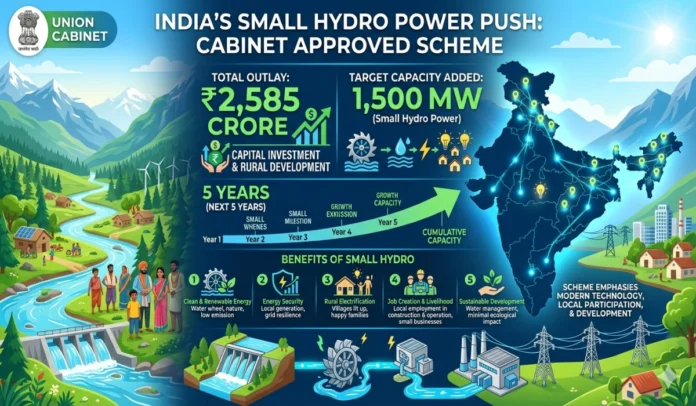
Union Cabinet approved a ₹2,585 crore scheme to add 1,500 MW of small hydro power capacity across India over the next five years.
The decision supports India’s renewable energy push while aiming to bring reliable electricity and economic activity to remote and hilly regions. It is expected to benefit states with high hydro potential but limited infrastructure.
According to an official government statement, the Small Hydro Power Development Scheme will be implemented from FY 2026–27 to FY 2030–31. The plan focuses on projects ranging from 1 MW to 25 MW, mainly in northeastern and mountainous states.
Under the scheme, central financial assistance will be provided to states. Northeastern states and border districts can receive support of up to ₹3.6 crore per MW, while other states will get up to ₹2.4 crore per MW, officials said.
“This concept uses the natural flow of the river to generate power without building a dam,” said Ashwini Vaishnaw, Union Minister for Information and Broadcasting, during a briefing on Cabinet decisions.
Small hydro projects generate electricity using the natural flow of rivers without the need for large dams. This reduces land use and limits displacement, making them suitable for environmentally sensitive areas.
The government expects the scheme to attract around ₹15,000 crore in total investment. It is also projected to create about 51 lakh person-days of employment during construction, along with long-term jobs in operations and maintenance.
For communities in remote regions, the projects could improve access to reliable electricity and support local economies. Workers in construction, engineering, and plant operations are likely to see new opportunities as projects are developed.
However, analysts note that projects in mountainous areas can face delays due to difficult terrain, limited road access, and harsh weather conditions.
The government will now work with states to identify suitable locations and begin project development. Early progress will depend on site approvals, funding allocation, and participation from private developers in the coming months.
