
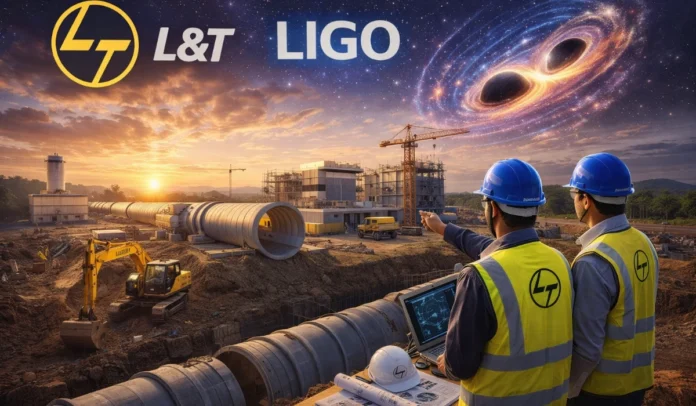
Engineering giant Larsen & Toubro (L&T) has secured a significant order worth between ₹1,000 crore and ₹2,500 crore from the Department of Atomic Energy to construct the LIGO-India Observatory in Maharashtra. This flagship “mega science” project will position India as a key player in global gravitational wave research by detecting tiny ripples in space-time caused by massive cosmic events.
The observatory, known as LIGO-India, will be built at Aundha in Hingoli district. It features an L-shaped interferometer with 4-kilometre-long arms designed to capture gravitational waves from phenomena like black hole mergers, neutron star collisions, and other extreme space events. These waves, first directly detected in 2015 by the US-based LIGO facilities, provide a new way to observe the universe beyond light and electromagnetic signals.
L&T’s Heavy Civil Infrastructure and Heavy Engineering verticals will jointly handle the project. Their scope includes designing and constructing the entire facility, manufacturing and installing an 8-kilometre ultra-high vacuum-compatible beam tube system, and delivering other precision infrastructure critical for the detector’s extreme sensitivity requirements. The work is expected to be completed within 48 months.
The project is a collaboration between Indian institutions such as the Raja Ramanna Centre for Advanced Technology (RRCAT), Institute for Plasma Research (IPR), and Inter-University Centre for Astronomy and Astrophysics (IUCAA), alongside the US LIGO Laboratory operated by Caltech and MIT. India will provide the site, vacuum systems, and infrastructure, while the US partners supply designs, hardware, and technical support.
LIGO-India will join the international network of detectors, including those in the US, Italy (Virgo), and Japan (KAGRA). Its location in the southern hemisphere will greatly improve sky coverage, allowing scientists to pinpoint gravitational wave sources more accurately and study events that current observatories might miss.
The initiative builds on India’s long-term involvement in gravitational wave science through the IndIGO consortium. Government approval for construction came in 2023, with the facility expected to start operations by the end of the decade. It represents a major investment in fundamental science and technology development.
