
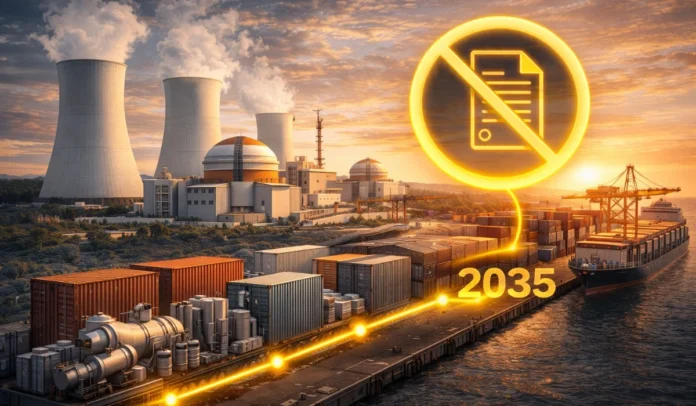
Finance Minister Nirmala Sitharaman announced an extension of basic customs duty exemption on imports of goods required for nuclear power projects until 2035, as part of the Union Budget 2026-27 presented today. The measure removes import taxes that previously stood at 7.5 per cent on key items, aiming to lower costs and speed up India’s nuclear energy expansion.
In her Budget speech, Sitharaman stated that the existing exemption would continue until the year 2035 and now apply to all nuclear plants, regardless of their capacity. This broadens the benefit beyond earlier restrictions tied to specific project sizes or types. Goods covered include nuclear reactors, fuel elements, non-irradiated cartridges, machinery for isotopic separation under tariff item 8401 30 00, and control/protector absorber rods or burnable absorber rods under 8401 40 00 all now at zero basic customs duty.
The decision follows recent policy changes, including the SHANTI Act that opened the nuclear sector to private participation for the first time. It supports India’s long-term target of reaching 100 gigawatts of nuclear power capacity by 2047, a significant jump from current levels. Nuclear energy provides reliable, low-carbon baseload power to complement intermittent renewables like solar and wind.
The exemption reduces project costs for imported equipment and components, which remain essential as domestic manufacturing scales up. It encourages faster deployment of new reactors and helps attract investment from both public and private players. Analysts say the move could make nuclear projects more financially viable amid rising global demand for clean energy and supply chain challenges.
This step fits into broader Budget efforts to boost energy transition and security. Alongside nuclear support, the government proposed duty exemptions on capital goods for battery energy storage systems and sodium antimonate for solar glass production. These measures aim to strengthen non-fossil fuel generation and reduce reliance on imports for critical technologies.
Industry observers welcomed the announcement, noting it removes a key cost barrier at a time when India plans major capacity additions. The Department of Atomic Energy received an allocation that aligns with these ambitions, though exact figures for new projects will depend on future approvals.
The extended zero-duty window until 2035 provides long-term certainty for developers and suppliers. It signals strong government commitment to nuclear power as part of the net-zero pathway and energy self-reliance goals.
