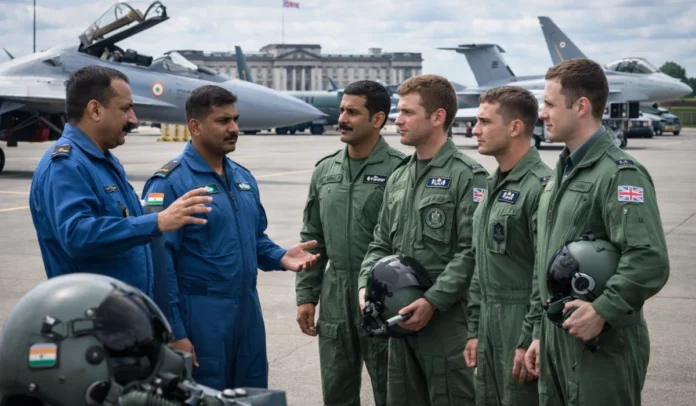
The Indian Air Force (IAF) will deploy three Qualified Flying Instructors (QFIs) to the United Kingdom to train Royal Air Force (RAF) fast jet pilots, marking a first-of-its-kind exchange that highlights deepening defence ties between the two nations.
The agreement was finalised during the 19th UK-India Air Staff Talks held in New Delhi from February 10 to 12, 2026. The IAF instructors will be posted at RAF Valley in Wales, the RAF’s primary base for advanced fast jet training. They will provide instruction on aircraft such as the BAE Hawk T2 and Texan T1, which are used for developing skills in aircraft handling, operational decision-making, and safety procedures.
This deployment, initially set for two years, represents the first time Indian QFIs will deliver fast jet training to British pilots at RAF Valley. It builds on earlier milestones in bilateral military cooperation, including the January 2026 posting of an IAF officer as an instructor at the Royal Air Force College Cranwell, the academy that prepares future RAF officers.
The arrangement underscores growing mutual respect for training standards and expertise between the IAF and RAF. It also reflects broader India-UK defence collaboration, which has seen increased exchanges in professional military education, operational training, and multi-domain activities.
Air Vice Marshal Ian Townsend, Assistant Chief of the Air Staff for the RAF, described the move as a significant step in strengthening the longstanding relationship between the two air forces. He noted that integrating Indian instructors into the UK’s military flying training system enhances interoperability and reinforces a shared focus on excellence in aircrew development.
The initiative follows an agreement on military training cooperation signed during UK Prime Minister Keir Starmer’s visit to Mumbai in October 2025. With Indian instructors now present across all three British military academies, the exchange signals a new level of trust and partnership in air power training.
This development is expected to benefit both sides through knowledge sharing, improved joint operational understanding, and stronger people-to-people ties within the armed forces. It comes at a time when both countries are modernising their air capabilities and addressing shared security challenges.
